Does talc cause cancer? [my research]
I've been seeing many Reddit posts floating around about this whole thing and decided to take a look into this. Mostly because buying talc-free makeup is an extra point of tension, and I want to know if it's worth it or not.
The idea is to look into this research myself and not rely on any summaries / AI. I have to say, that is not very easy, but I think it is good to fight against intellectual fast-food. I have started my research from the vague idea that EU is about to ban talc in 2027. Why? What is it that they are basing this decision on?
Here we go, tldr is at the end.
European Chemicals Agency (founded in Helsinki in 2007) published the report of the discussion, where it was decided that talc warrants "Carc. 1B" classification. Let's take a look at who exactly was making that decision.
Note: I have originally wanted to load up Summary Record of the Proceedings, Conclusions and action points of ECHA to NotebookLM to help me find the relevant bits of info there, since the document itself is 64 pages long. Guess what:

I will leave the image to speak for itself and will make no further comments on this.
The members recommending labelling talc a carcinogen is RAC (Committee for Risk Assessment at ECHA). Here is a list of members, their CVs, and Declarations of Interest. Took a look at their CVs, many of them are relevant, but there are some which are not for this specific issue (like the person specializing in Geoecology). For traceability, it would be nice to see who exactly participated in that part of the discussion. It is possible it's written somewhere in the document, I just have not been able to find it. It would also be great to have easy access, or at least citations, to the studies that the unknown RAC members used.
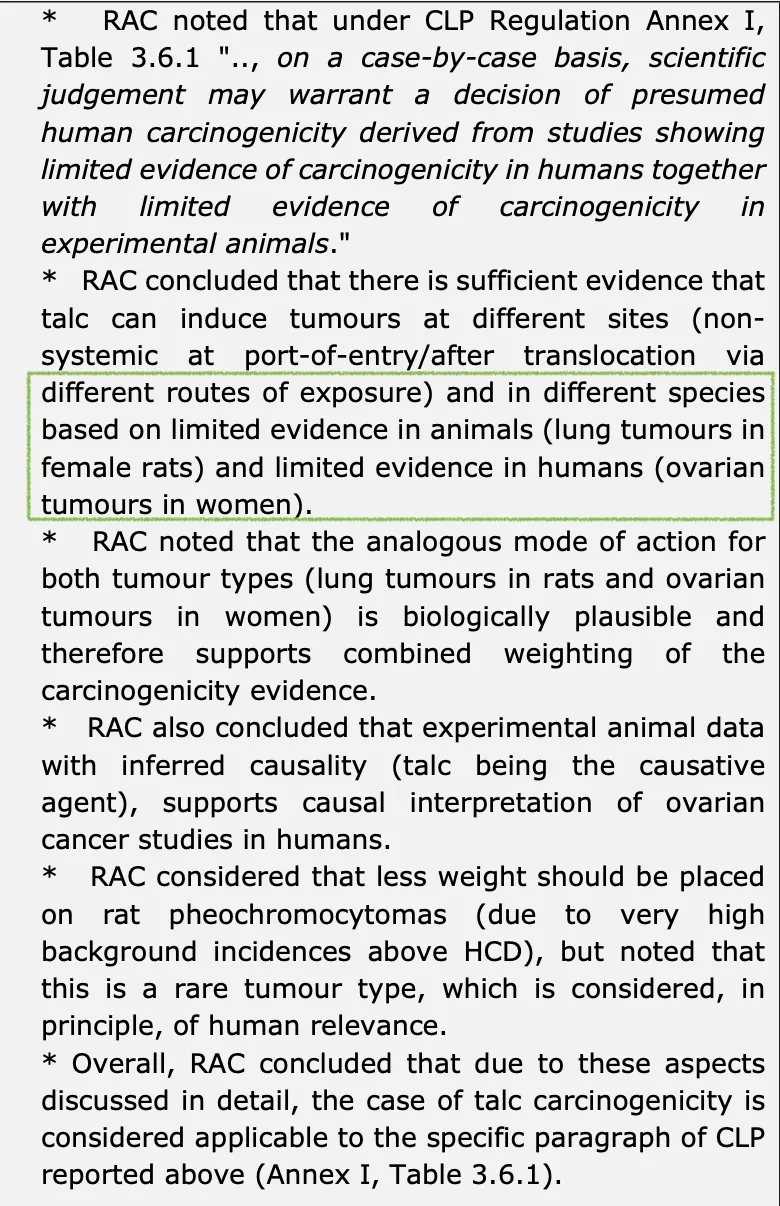
According to the document, there is limited evidence of risks found in rats (lung cancer) and women (ovarian cancer). The specific classification of talc is "B1 H350, STOT RE 1; H372 (lungs, inhalation)".
What exactly B1 H350, STOT RE 1; H372 means is in Regulation (EC) No 1272/2008 on the Classification, Labelling and Packaging of substances and mixtures. From the document:
- H350: May cause cancer (state route of exposure if it is conclusively proven that no other routes of exposure cause the hazard)
- STOT RE 1: Specific target organ toxicity — repeated exposure
- H372: Causes damage to organs (state all organs affected, if known) through prolonged or repeated exposure (state route of exposure if it is conclusively proven that no other routes of exposure cause the hazard)
So, what this classification means is that repeated inhalation of talc may cause lung cancer. According to the document, the conclusion was drawn from animal studies (rats), not humans, since ovarian cancer, or use on/around genitals is not mentioned.
This would mean that powders containing talc are out (especially loose powders, obviously). Why did the statement mention nothing of ovarian cancer? Let's look at the studies.
I am not a scientist, so I just went on scholar.google.com and started straight-up reading up the studies. In the future, it would be good to learn more about how credible the journal is, and how high of a citation index the publishing should have for it to be relied on by a non-professional. For now, I am checking that the journal is not in Beall's list and that the impact factor is high-ish.
The systematic review from Critical Reviews in Toxicology, impact factor is 4.1 (2024) states extremely high exposure of talc likely resulted in lung particle overload, not carcinogenic properties of talc:
the studies cover multiple exposure routes, species, and exposure durations, and none indicate that talc is a carcinogen in experimental animals except in rats under conditions of extremely high exposure that likely resulted in lung particle overload, a nonspecific effect of high exposures to poorly soluble particles, and not from any carcinogenic properties of talc. Lung particle overload leading to lung tumor formation has only been observed in rats and not in any other species, including humans. The mechanistic studies indicate that talc is not genotoxic or mutagenic, but can induce some effects that could be events on a possible pathway to carcinogenicity, mainly at high exposures or in in vitro studies with exposures of unclear relevance in vivo, but these effects are not consistent across studies and cell types. <...> This systematic review of the experimental animal carcinogenicity and mechanistic evidence for talc indicates that an association between talc exposure and cancer is not expected in humans. Talc carcinogenicity is not plausible in any species except rats, and only when the exposure conditions are high enough to induce lung particle overload, which is not relevant to human exposures. Link
In the same article, Andrey A. Korchevskiy claims that classifying talc as a carcinogen is false:
There is no mode-of-action demonstrated for talc that would prove it to be a human carcinogen.
To which he gets a snarky answer by Alessandro Francesco Gualtieri, I will quote this because I think it's entertaining:
First of all, on page 6, 4.1.2. What is talc, the definition of talc given by Korchevskiy and Wylie (Citation2025) is incomplete. Talc is not just a mineral (natural material) but also a synthetic product. The IARC v.136 Working Group also considered the synthetic counterparts because it is foreseeable that these products, being asbestos-free, will be able to acquire more and more market share in the future. On page 6, 4.1. Mineralogy of talc, Korchevskiy and Wylie (Citation2025) state that “With such poor understanding of the occurrences of talc and associated minerals, it is difficult to see how exposures were evaluated, especially with respect to possible presence of elongate particles in talc samples”. It is undeniable that talc mineralogy is a complex matter and that talc samples are often composed of a mix of minerals with various particle shape, including elongated, fibrous, and asbestiform. <...> Regarding the “evaluation of the exposure”, Volume 136 clearly report (page 52, line 10–14) that the description of the mines does not necessarily describe workers’ exposure or products derived from them. With the macroscopic criteria considered by Korchevskiy and Wylie (Citation2025), it is impossible to apply the term “asbestiform” to that tremolite “asbestos” particle. As a matter of fact, classification of regulated (respirable) carcinogenic fibers is based on their (fibrous) shape and size (particle length L ≥ 5 µm long, particle width W < 3 µm, and aspect ratio L:D ≥ 3:1: WHO Citation1997) and not on whether they are asbestiform. The author has provided references and explanations to support the data reported for the major talc deposits worldwide in Table 1.1 and in Volume 136, and to substantiate the concern expressed by the IARC Working Group regarding the potential for asbestos contamination in talc deposits around the world. As a mineralogist, the author is fully aware of the complexity of talc mineralogy, including issues related to mineral associations, particle morphology, and the relationships among individual mineral species. The data drawn from the literature and used to compile the table are inevitably fragmentary, often dated, and largely qualitative in nature; nevertheless, they are the result of an analysis conducted with the utmost care and with an objective and unbiased approach.
Spicy! No closer to understanding the reality, but I did gather that the community is divided on the issue. And that the back and forth in scientific journals is juicier than any internet drama.
Let's look at other publications, as sad as I am to leave the ever so entertaining Critical Reviews in Toxicology.
Frontiers in Public Health, Occupational Health and Safety, Impact factor 4.1 (the higher the better) found no correlation between talc and cancer:
Integrating all streams of evidence according to the IOM framework yielded classifications of suggestive evidence of no association between inhaled talc and lung cancer and pleural mesothelioma at human-relevant exposure levels.
European Journal of Cancer Prevention, Impact factor 2.1 found no correlation between talc and cancer:
Talc is not genotoxic. Mechanistic, pathology and animal model studies have not found evidence for a carcinogenic effect. In summary, these data collectively do not indicate that cosmetic talc causes ovarian cancer.
Journal Epidemiology (Impact factor 4.4) found the link between talc use and ovarian cancer:
In general, there is a consistent association between perineal talc use and ovarian cancer. Some variation in the magnitude of the effect was found when considering study design and ovarian cancer subtype.
Journal of Aerosol Medicine and Pulmonary Drug Delivery with Impact factor of 2.2 found that cancer could be caused by talc inhalation:
This extended tissue residence is considered to constitute a continuing tissue exposure that is capable of inducing the documented inflammatory and proliferative response. There is less consensus as to whether there is a threshold fiber length effect, as long, thin fibers (>5 μm) form only a small fraction of talc aerosols and the possible role of fibers >5 μm in the translocation from the lung to the pleura and their association with pleural fibrotic and carcinogenic lesions. Long, thin fibers are preferentially deposited in hot spots in the lung, such as airway bifurcations, areas typically associated with the development of lung cancer. The platy structures typical of talc can form oblate structures behaving more as fibers in the air stream, and these have also been shown to deposit preferentially in such locations. The review of the inhalation toxicity of talc provides a plausible explanation for the carcinogenic potential of RTP.
TLDR; The evidence that I have been able to find is divisive and the decision made by European Chemicals Agency lacks transparency (who exactly made the decision and what is their education and affiliation? what studies did they base their conclusions on? and why did they not mention ovarian cancer?), which would let me trust it without double-checking.
I am now left with more questions than I had when I just started. I will not stop using my eyeshadows with talc just yet but will not be buying new ones, either.
I need some time to research this more, but felt it was important to share the results so far.
I am not a scientist, but it is important for non-scientists to have access to the scientific discourse to make their own informed decisions. I am doing my best and want to get better at it. This blog post is nowhere near comprehensive enough for the subject, however it is a good outline of what casual research looks like for a layman.
How helpful is it that so many articles were in open access? Please contact me if you have anything to say on the topic or if you have made your mind with a high level of certainty.